Tuesday, November 17, 2015

Analyzing a TED Talk

Ted Talk Analysis

By: Sam Schulte


The storefront of 826 Valencia
At TED2008 in Monterey, California, Dave Eggers presented his TED Talk, “My wish: Once Upon a School” to inform people of the possibilities of helping students and schools and the amazing effect it can have. Dave Eggers spoke to an audience of people who were interested in helping local communities and schools. The speaker introduced his topic by describing the rarity of one-on-one time between teachers and students. He notes that this is especially a problem in underfunded schools. Dave continues by telling the story of how he started his own tutoring business in San Francisco, 826 Valencia. In the front of the building, it was a gig pirate store, but in the back it was a tutoring center combined with Egger’s publishing company. The tutors at the center are people who work for the publishing company, and after they’re done with their workday, children get out of school and come for one-on-one tutoring. Often times, the children come from bilingual households so the parents will come with the students to watch the tutoring sessions. This reminded me of Homework Help!

Working buccaneers can buy supplies at 826 Valencia!

Dave’s talk was especially interesting to both the audience and me because he had a slideshow filled with pictures of 826 Valencia. Since the building was zoned for retail, Dave needed to sell something, which is how the pirate supply store came to be. The pictures were hysterical because it was such a silly concept that it almost seemed unreal, but it is indeed a tutoring center. In fact, many other people have since then started their own tutoring companies with show storefronts (Superhero supply store, Time Travel mart, etc.). The visual pictures were helpful to visualize the tutoring taking place.

The speaker also had a very authentic sense of humor through sarcastic comments. The audience thought he was pretty funny and they often started laughing in the middle of his sentences so he had to slow down and wait until he could start talking again. Moreover, Dave had excellent “conversational quality”. I felt as though he was talking to me on a personal level, even though I don’t know him and wasn’t there for his talk. However, he did have room for improvement as a speaker. Sometimes, he spoke a little too fast and I had to rewind and listen to his sentence again to understand what he was saying. Additionally, his sentences were filled with “um” and “uh”, which was extremely distracting to me. His talk was almost 25 minutes long, so he definitely didn’t stick to the 18-minute rule. However, I was so intrigued with the topic that I honestly didn’t notice it was that long. I noticed sometimes he would get excited and carry-on about the pirate store or interactions with students that he went longer than he should have.Overall, I think that Dave Eggers did a great job of staying in his lane. 


One-on-one tutoring at 826 Valencia
Although at times he would spend a little too long telling a specific story about tutoring, it still related to his point. He painted a good mental picture because he described his tutoring company in detail. He even went on to explain that eventually some of the tutors from 826 Valencia began working at the actual schools with students. His presentation relates directly with my service organization. At Homework Help, we are tutors that work one-on-one with students. Dave said that about forty hours of one-on-one time between a student and a tutor can raise a student’s grade by one letter. Wow! That’s pretty substantial growth for students. That makes me feel really good about what we do at Homework Help. It truly is making a difference for the kids.


Watch Dave's TED Talk here

Saturday, November 7, 2015

Analyzing a TED Talk: Teacher-Student Relationships

Interacting With Students - A Speech Analysis


By Jacob Whitmore

Video from www.ted.com

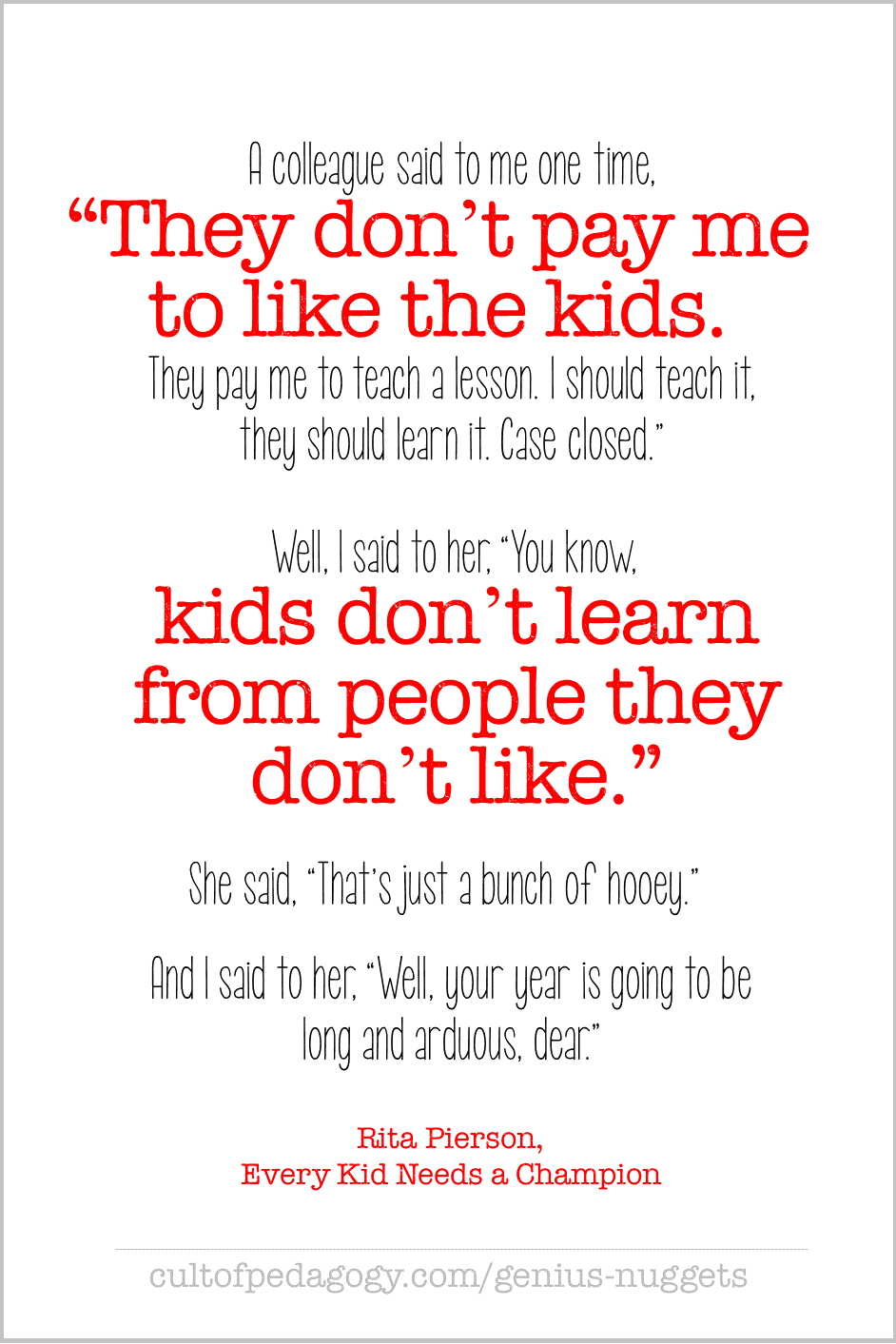
In April of 2013 in New York City, New York, Rita Pierson, an educator with 40 years of experience, gave her presentation “Every kid needs a champion” to inform others that teacher-student relationships need to be stronger in order to increase academic success. The audience was simply a group of spectators who knew that the talk was associated with education in some form, not knowing what was to be discussed. In her speech, you can see her passion about the importance of relationships with students, delivering her speech in a heart-warming, sincere manner while always stressing the importance of proper interaction with the students. She tells stories about students in her classroom and about other educators and their thoughts. These stories connected with me and the audience as she showed her true feelings about her duty as a role model and source of inspiration for her students. As she spoke, it felt like Ms. Pierson was holding a conversation with each person in the audience. The tone and emotion in her voice, including the certain manner in how she pronounced her words, made her seem like she was talking to the audience as people rather than spectators, moving her hands and pointing into the audience to physically interact with them as well.

Ms. Pierson opened my eyes to just how important it is to look at students not simply as those receiving information but as people with drives and feelings. She talked about how it is okay for
Photo Credit: www.cultofpedagogy.com
teachers to apologize to students; it makes it seem like teachers are looking at the students as people rather than inferior humans. Treating students in this manner can impact their lives, as she saw at her mother’s funeral. Her mother, a fellow educator, took care of her students by providing them with both emotional support and physical care. At her funeral, Ms. Pierson was awestruck with how many students showed up to pay their respects to her mother. I believe this was Ms. Pierson’s jaw-dropping moment as it exemplifies just how important it is to treat students kindly, affecting them as people and how they behave later in life; you do not often hear about students at a teacher’s funeral. Along with impactful moments like this, Ms. Pierson also incorporated humor multiple times in her speech. She mentioned specific examples of student reactions in class, including one student not understanding why there was a smiley face on a failed assignment. The audience laughed at each example, showing their engagement in the speech. 

The speech was only 8 minutes long, so it never felt like Ms. Pierson was giving an overload of information. Because her speech was short, she had to pick key topics to talk about in that restrained time. She talked about what others thought, what she has done, and how it is important to establish quality relationships, and it never felt like she lingered too long in any area. The use of her examples, in which she imitated how the students reacted, helped paint a mental picture. She gave quick examples and did not go into great visual detail about situations, which could have been enhanced, but her audio descriptions of people and situations were wonderful. In my opinion, I believe Ms. Pierson stayed in her lane as she talked strictly about her personal experiences as an educator.

Photo Credit: donornation.org
Overall, I felt the presentation was extremely persuasive. You could feel Ms. Pierson’s sincerity in the entire speech, and her delivery with her voice was exceptional. At the Homework Help, we are supposed to treat each student with sincerity, kindness, and a positive attitude, providing an open atmosphere that differs from the classroom and in which the students can feel like they can relate to us; we treat the students as fellow people, not simply as a student in a class. Ms. Pierson’s speech really showed me just how important it is to understand others and to treat everyone with kindness to bring out anyone’s potential.

If the video is not working for some reason, you can watch it here.

Monday, October 26, 2015

A Typical Night at the Village Public Library

by 

Bobbi Lin

I have volunteered several nights and thought I would let you guys know about a typical night of service based an experience from most nights with a little girl named Ashley.  Hope you enjoy!

Drake and Jacob working together to help a student.
Sam helping a little girl.


Video Reflection 2


Video Reflection 2


Hello there, it's Drake again. This week I made a video about the importance of considering my role as a volunteer. We have visited the Lexington Public Library approximately 14,637 times by now. Warning: This video contains only 1% of the amount of luchador fighting you might expect.


I also have been looking for an excuse to post the most beautiful sentence in the English language, which I just-so-happened to find hidden in a very advanced assignment for a student with whom I was working.

(Photo credits Drake Boling, copyright 2015)

Video Reflection 2

It's the Little Things


By: Sam Schulte


As Midterms roll around, I've lost track of how many visits I've had to the Lexington Public Library, but there have been quite a few. Each time, there are several things that make me smile and laugh and remind me why we're doing this service learning project. However, there are also times when I leave very frustrated that I wasn't able to effectively help every student.

This past visit, I had by far the most meaningful interaction with a student since I've been helping there. It was short and simple, but it really meant a lot to me, and it's stuck with me since leaving last week. For your viewing pleasure, here's a video of me talking about it.


Okay, really. I'm can't stop laughing thinking about her! She was so funny and full of life. Kids like her really make going to Homework Help fun, no matter how stressful it can be at times. 

She's a phonics rockstar!

Batty and his two friends, Little Kitty and Big Kitty


Tuesday, October 20, 2015

When All Else Fails, Google It/Video Reflection 2

Google and the Underlying Issue

By Jacob Whitmore

Hey guys. So with this post, you get to see me and hear me talk! That's great, right? Maybe not. But I wanted to answer a question I've been asked a few times since I've been working with the Homework Help organization. The photos below give a little insight into what I'm talking about. Hopefully it answers that question that some of you might have thought, and it might raise other questions about the kids' education in general. At least I think it's something to really mull over. I hope you guys like it!


Making sure we're spelling correctly...
(Photo Credit: Jacob Whitmore)
...to discussing the U.S. economic system.
(Photo Credit: Jacob Whitmore)


Sunday, October 4, 2015

Are you Smarter than a Fourth Grader?

By Bobbi Lin


This is a little embarrassing but let me say I will not be appearing on any game show testing my knowledge against any fourth or fifth graders.   Let’s just say I am happy to have access to my cell phone at times during the Homework Help visits at the Village Public Library. 

While most of the time I have helped first and second graders with spelling homework consisting of repeatedly writing the words (once with pen, then pencil, then marker) but there has been a few occasions that make me doubt my own knowledge.

On a recent visit I was tag teamed with two young men in the same class with math homework.   Normally we help one child at a time but these two wanted to work together and with so many waiting it seemed like a good idea.   One student was loud and funny and I would bet is the class clown as I heard a series of jokes in between problems. The other was quiet and quite the future mathematician.   I was amazed when he multiplied twenty-seven by fifth-six in his head correctly but then reminded of his need for help when he guessed at seven times four. 

 This homework consisted on problems involving order of operations.  At times, I freely admit I doubted myself especially when these two students came up with different answers.   

 Image result for order of math operations 
The quiet student kept saying "Please Excuse My Dear Aunt Sally”.   Was it a private joke? Nervous chant?  The loud student kept speaking in Spanish and singing “PEMDAS” in different voices.  After hearing this repeatedly for about 10 minutes, I finally decided to google pemdas and see what all the giggles were about hoping I could bring his attention back around.


Image result for order of math operations

Well much to my relief this is a technique teachers use to help students remember the order of operations.
 It stands for "Parentheses, Exponents, Multiplication and Division, and Addition and Subtraction".

 Now I am older than most students (and some professors) and it has been some 30 plus years since I was taught about order of operations.  To be honest I don’t even remember learning about this but I sure Aunt Sally was not involved.

I have to admit I was just glad to have the refresher and to know the students were not just playing around but honestly attempting to think through the problems. 

Thank you Aunt Sally.